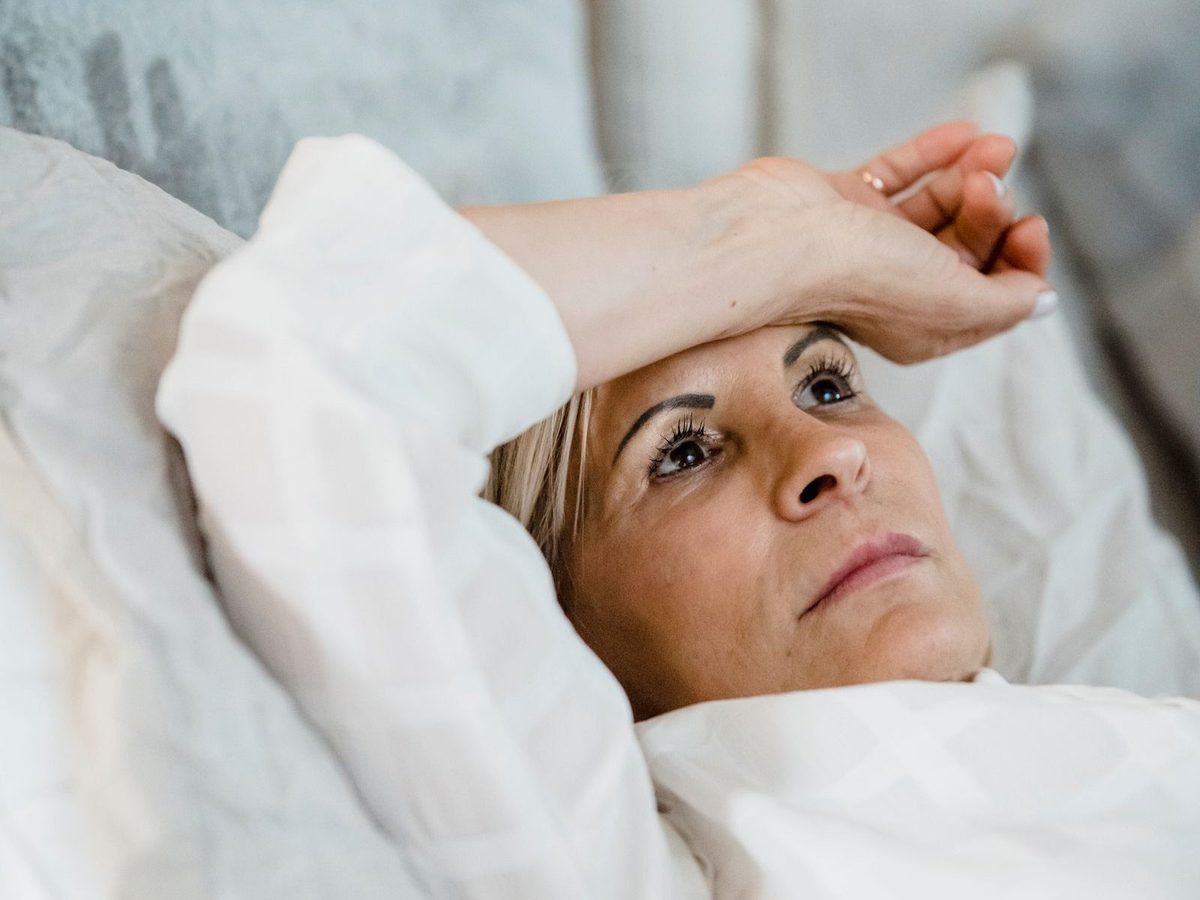
It’s 3:07 a.m. You’re wide awake again. Maybe you’re a little sweaty, maybe your heart is racing, or maybe you just woke up for no clear reason, and now your brain has started its overnight to-do list. If this happens to you most nights, you’re far from alone.
Sleep problems are one of the most common and most frustrating parts of the menopause transition. Research summarized by The Menopause Society shows that sleep disturbance affects 40% to 60% of women in perimenopause and after menopause. Waking in the middle of the night and struggling to fall back asleep are the sleep symptoms women find most bothersome.
Here’s what’s going on, what can help, and when it’s time to talk with your clinician.
Why perimenopause and menopause wake you up in the middle of the night
1. Shifting hormones affect the sleeping brain directly
During perimenopause, estrogen and progesterone don’t simply fall in a straight line. They rise and dip unpredictably, and over time estradiol (the main form of estrogen) trends down while follicle-stimulating hormone (FSH) rises.
A study in The Journal of Clinical Endocrinology & Metabolism found that lower estradiol and higher FSH were each linked to more night-time awakenings. That held true even after accounting for hot flashes and low mood. In other words, hormone changes can break up your sleep on their own, even on nights you don’t notice a hot flash.
Progesterone may play a part too. In the brain it has a calming, sleep-supporting effect, though studies haven’t settled how much its decline adds to night-time waking. Many women notice their sleep feels lighter and easier to interrupt as their cycles become irregular.
2. Night sweats (hot flashes at night)
Night sweats are hot flashes that happen while you sleep. Even a mild one can pull you out of deep sleep, sometimes before you realize you’re warm. The Menopause Society notes that night sweats “often cause sleep disruption,” along with the discomfort of damp sheets and clothes. They’re among the most common reasons women in midlife wake up at night.
3. Your body clock is shifting
As we move through midlife, our internal clock tends to run a little earlier: sleepier earlier in the evening, awake earlier in the morning. Melatonin, the hormone that signals “it’s night,” also declines with age. Put those together and the early-morning hours become a fragile window where sleep is easier to lose.
4. Stress, worry and a busy midlife
Midlife often brings aging parents, teenagers or grown kids, demanding jobs and big life questions, all at once. Harvard Health notes that anxiety is very common around menopause, and racing thoughts tend to show up in the quiet of the night. Once you’re awake and stressed, your body gets more alert, which makes drifting back off even harder.
5. Other things that pile on
Middle-of-the-night waking usually has more than one cause. Other common contributors include:
- Bladder changes: needing to urinate once or more at night
- Alcohol: it may help you fall asleep but leads to lighter, broken sleep later in the night
- Caffeine late in the day or a large late meal
- Joint or muscle aches that flare when you lie still
- Some medications that can fragment sleep
- Sleep disorders such as sleep apnea and restless legs syndrome, which become more common in midlife
The Menopause Society points out that sleep apnea, insomnia disorder and restless legs all increase around menopause. That’s one big reason to bring ongoing sleep problems to your clinician rather than assuming it’s “just hormones.”
What can help you sleep through (or fall back asleep faster)
There’s no single fix, but small changes add up, and real treatments exist when they’re not enough.
Set up your bedroom for a hotter body
- Keep the room cool, dark and quiet.
- Layer light, breathable bedding you can kick off, and keep a glass of cold water by the bed.
- Moisture-wicking sleepwear can make night sweats less disruptive.
Protect your body clock
- Go to bed and get up at about the same time every day, weekends included.
- Get daylight in the morning and keep screens out of bed in the evening.
- If you nap, keep it short and early. The National Institute on Aging recommends avoiding late-afternoon or evening naps.
Rethink evening habits
- Move your body most days, but finish vigorous exercise a few hours before bed.
- Keep caffeine to the morning and notice how alcohol affects your nights. Even a small amount can make it harder to stay asleep.
- Avoid big meals right before bed.
When you wake at 3 a.m.
- Don’t check the time over and over. Clock-watching feeds the worry loop.
- Try a slow-breathing pattern (for example, breathing out longer than you breathe in) or a body scan.
- If you’re awake for what feels like 20 minutes or more, get up and do something calm in dim light, like reading a paper book, then go back to bed when you feel sleepy. This keeps your bed linked with sleep, not frustration.

Ask about CBT for insomnia
Cognitive behavioral therapy for insomnia (CBT-I) is a structured, drug-free approach that helps retrain sleep habits and the anxious thoughts that keep you awake. The Menopause Society recommends considering it for persistent sleep problems, and the NIA notes it has been shown to help women with menopausal symptoms. It’s available in person, online and through some apps.
Talk with your clinician about treatment options
If hot flashes and night sweats are driving your wake-ups, treating them often improves sleep. Hormone therapy is one option for many women, and there are non-hormonal options too. The right choice depends on your health history, so talk with your clinician about the benefits and risks for you. Your clinician can also check for other causes, like thyroid changes, sleep apnea, mood changes or medication side effects.
Track it so you (and your clinician) can see the pattern
One of the most useful things you can do is write down what happens. Note when you wake up, whether you felt hot or sweaty, what you ate or drank in the evening, your stress level, and where you are in your cycle if you still have periods. After a couple of weeks, patterns often appear: maybe the 3 a.m. wake-ups cluster after wine, after a stressful day, or in the days before your period.
That record also makes your appointment far more productive. Instead of “I’m not sleeping well,” you can say “I wake up 4–5 nights a week around 3 a.m., usually after a night sweat.”
Menovia can do this for you. Log night sweats, sleep and mood in one tap, and Ziena™, Menovia’s AI companion, helps you spot the connections and turns them into a provider-ready report you can bring to your next visit. Menovia is built by physicians and made for perimenopause and menopause.
Download Menovia: App Store · Google Play
When to see your clinician sooner
Talk with your clinician if:
- Poor sleep is affecting your mood, memory, work or safety (for example, drowsy driving)
- You snore loudly, gasp or stop breathing in your sleep, or wake with headaches. These can be signs of sleep apnea.
- You have an uncomfortable urge to move your legs at night
- Night sweats are drenching, or come with fever, weight loss you can’t explain, or other new symptoms
- You’ve tried better sleep habits for a few weeks and nothing has changed
Frequently asked questions
Is waking up at 3 a.m. a sign of perimenopause?
It can be. Night-time waking is very common in perimenopause, and research links it to falling estradiol and rising FSH, even without hot flashes. But many other things cause 3 a.m. waking too, so look at the bigger picture, such as changes in your periods, night sweats or mood, and talk with your clinician.
Why do I wake up at the same time every night?
Your body clock, stress hormones and lighter sleep in the second half of the night all play a role. Once you’ve woken at a certain time a few nights in a row, worry about waking can keep the pattern going.
Does menopause cause you to wake up in the middle of the night even after periods stop?
Yes. Sleep problems often continue after menopause, especially with ongoing night sweats, and sleep disorders like sleep apnea become more common with age. The good news is that they’re treatable.
Will my sleep get better after menopause?
For many women, night sweats and sleep disruption ease with time. That timeline varies a lot, and you don’t have to wait it out. Talk with your clinician about what can help now.
Should I take melatonin for menopause sleep problems?
Some women try over-the-counter sleep aids such as melatonin. The NIA notes that sleep aids are not a cure for insomnia and shouldn’t be used long term. Talk with your clinician before starting any supplement or sleep medication, especially if you take other medicines.
What should I track to figure out why I’m waking up?
Wake-up times, night sweats, evening alcohol and caffeine, exercise, stress and your cycle. Two to four weeks of notes is usually enough to show a pattern you can share with your clinician.
Related reading
- Beyond Tired: How to Manage Perimenopause Fatigue
- When the Heat Rises: Understanding and Managing Intense Hot Flashes
- Your Brain on Menopause
- Navigating the Hormone Therapy Decision
Sources
- The Menopause Society. “Sleep and menopause” (Practice Pearl), Menopause journal. https://journals.lww.com/menopausejournal/fulltext/10.1097/gme.0000000000002585~sleep-and-menopause
- Coborn J, de Wit A, Crawford S, et al. “Disruption of Sleep Continuity During the Perimenopause: Associations with Female Reproductive Hormone Profiles.” The Journal of Clinical Endocrinology & Metabolism, 2022. https://pmc.ncbi.nlm.nih.gov/articles/PMC9516110/
- The Menopause Society. MenoNote: “Night Sweats. What If It’s Not Menopause?” https://menopause.org/wp-content/uploads/for-women/MenoNote-Night-Sweats.pdf
- National Institute on Aging. “Sleep Problems and Menopause: What Can I Do?” https://www.nia.nih.gov/health/menopause/sleep-problems-and-menopause-what-can-i-do
- Harvard Health Publishing. “The 3 a.m. wake-up: Why it happens to women more often after 55.” https://www.health.harvard.edu/sleep/the-3-am-wake-up-why-it-happens-to-women-more-often-after-55
- Sleep Foundation. “Perimenopause and Sleep Issues: Causes and Solutions.” https://www.sleepfoundation.org/women-sleep/perimenopause-and-sleep
- The Menopause Society. “Symptoms.” https://menopause.org/patient-education/menopause-topics/symptoms
Clinically reviewed by Menovia clinicians. Menovia is built by physicians.
This article is for general education and is not medical advice. Always talk with your clinician about what's right for you.